
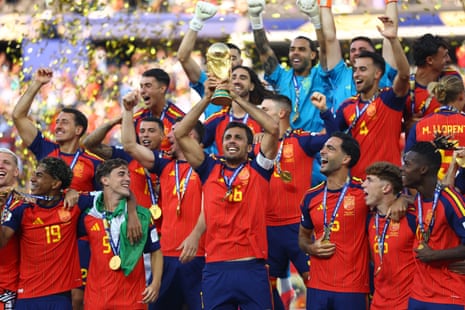
Yesterday, Spain won the FIFA World Cup. Yet, before the tournament began, statistical models estimated that Spain had only a 16.1% chance of becoming world champions. If Spain had only around a one-in-six chance of winning the tournament, how did it end up lifting the trophy?
The answer is not only about football. It is also about economics.
The key is understanding what statistical models actually do. They do not tell us what will happen. Instead, they estimate how likely different outcomes are, given all the information available at that moment.
Think about flipping a coin. The probability of getting heads on any individual flip is 50%, but that does not mean that every second flip will be heads. You could easily observe five heads in a row. The probability tells us what is likely over many repetitions, not what must happen in a single event.
Football is much more complex than a coin toss. Teams face different opponents, their form changes throughout the tournament, injuries and suspensions affect performance, and matches may even be decided after extra time or penalties. As the tournament progresses, every match also provides new information about how strong each team currently is.
To estimate these probabilities, statistical models combine information such as recent performances, the quality of previous opponents, goals scored and conceded, and measures of team strength such as Elo or FIFA ratings. Recent matches are usually given more weight than games played several years earlier because teams constantly evolve. Rather than making a simple prediction such as “Spain will win the World Cup”, the model estimates the probability of many different possible outcomes.
Winning the World Cup, however, is much harder than winning a single match. A team must survive every round of the competition, often against increasingly stronger opponents. To estimate each team’s overall chances, the probabilities generated by the statistical model are used to simulate the entire tournament thousands of times. In each simulation, every match is played according to the probabilities estimated by the model, so stronger teams are more likely to win, but surprises can still happen. After repeating the tournament thousands of times, the computer simply counts how often each team becomes champion. Spain won around 16% of those simulated tournaments, giving it a 16.1% chance of lifting the trophy before a single ball had been kicked.
So why did Spain’s probability increase during the tournament? Because probabilities are constantly updated as new information becomes available. Once Spain qualified from the group stage, it could no longer be eliminated there. Once it reached the quarter-finals, all earlier rounds had already been successfully negotiated. At the same time, the model incorporated Spain’s performances throughout the tournament, together with new information such as injuries, suspensions and the strength of the remaining opponents. By the time Spain reached the final, the question had changed completely. We were no longer asking, “What was Spain’s probability of winning the World Cup before the tournament started?” Instead, we were asking, “Given everything that has happened during the tournament, what is Spain’s probability of winning one remaining match?” This is known as conditional probability: updating probabilities as new evidence becomes available.
Economists think in exactly the same way. Rather than predicting with certainty whether inflation will rise or whether a policy will succeed, economists estimate the probability of different scenarios using the best information available. As new evidence emerges, those probabilities are updated. Banks estimate the probability that borrowers will default, insurance companies estimate the probability of accidents, and governments assess the likelihood that public policies will achieve their objectives.
Spain’s victory therefore does not show that the original prediction was wrong. Quite the opposite. A team with a 16% chance is expected to win roughly one out of every six comparable tournaments. This time, Spain happened to be that winner. Economics is not about predicting a single future; it is about understanding uncertainty and making better decisions when the future is unknown.


Leave a comment