The north-eastern Spanish region of Aragón is seeing some of the highest temperatures of the heatwave and, in the cities of Zaragoza and Huesca, local authorities have responded by reducing the price of entry for public swimming pools.” – BBC News, 23 June 2026.
Sofia (@dailylifeecon) grew up in Zaragoza, one of the cities mentioned by the BBC this week. Summer temperatures are always high there, but this heatwave has been particularly striking, making the city feature in an international news story. The most interesting part of the story, however, is not only the high temperatures, but the policies that governments (and in this case local governments) introduce in response to everyday challenges.
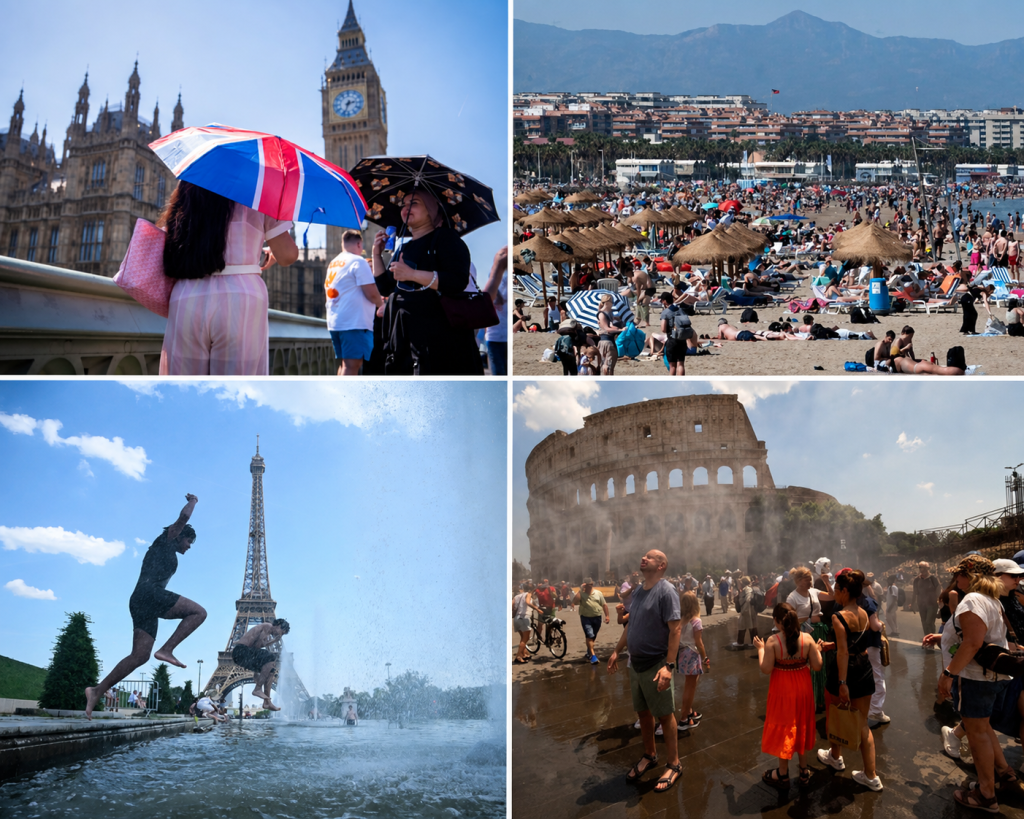
Over the past few weeks, Europe has experienced one of its most intense early-summer heatwaves on record. Temperatures have exceeded 40°C in several countries, schools have closed, outdoor work has been restricted, healthcare systems have prepared for increases in heat-related illnesses, and governments have been forced to rethink how cities cope with extreme temperatures. The World Meteorological Organization (WMO) has highlighted the role of heat-health action plans in saving lives and reducing economic disruption during extreme heat events. Climate change is making heatwaves more frequent and more severe, but what is perhaps less obvious is that it is also changing economic policy.
Take Zaragoza as an example. Whenever the city’s Municipal Emergency Plan is activated because of extreme heat, the local authority automatically reduces the price of admission to its municipal swimming pools by up to 50%. During the hottest periods of the summer, it also organises free-entry days at selected sports centres so that residents have access to places where they can cool down safely.
From an economic point of view, by reducing the price of swimming pools, the local government is effectively subsidising access to a public facility. The objective is not simply to increase leisure activities, but to reduce the health risks associated with extreme temperatures. Lower prices encourage more people, particularly lower-income households, to use facilities that can prevent heat exhaustion and heatstroke. In economics, this is an example of government intervention designed to improve social welfare when markets alone may not produce the best outcome (Carleton et al., 2025).
Zaragoza is not alone. Across Europe, cities are introducing policies to adapt to rising temperatures. Paris has expanded urban greening, including large-scale tree planting, to reduce the urban heat island effect. Barcelona has developed an extensive network of climate shelters in libraries, schools and community buildings where residents can escape the heat. Other European cities are redesigning streets, planting more trees, installing drinking fountains, encouraging cool roofs and improving building insulation to make neighbourhoods more resilient during extreme weather events.
All these policies, some short-run and others medium- or long-run, share the same economic objective: reducing the social and economic costs of extreme heat.
Heatwaves affect far more than our comfort. They reduce labour productivity, increase electricity demand, place pressure on healthcare systems, disrupt transport networks and disproportionately affect vulnerable groups such as older people, young children and low-income households (García-León et al., 2021; Costa et al., 2024).
But why do governments intervene instead of leaving individuals to decide how to cope with extreme heat? The answer lies in the fact that the costs and benefits of adaptation are not borne solely by the individual. Not everyone has the same ability to protect themselves: some households cannot afford air conditioning, others live in poorly insulated homes, and the elderly or those with underlying health conditions are particularly vulnerable. Moreover, when people cannot cope with the heat, the consequences extend beyond them. Hospitals face greater pressure, businesses experience lower productivity, energy systems become more strained and transport networks are disrupted. At the same time, many adaptation measures (such as climate shelters, urban trees, shaded public spaces and municipal swimming pools) benefit entire communities rather than only the people who directly use them. These are precisely the types of situations in which economists argue that well-designed public policy can improve social welfare by correcting market failures, addressing externalities and providing goods whose benefits extend across society.
Heatwave policy is therefore not simply about comfort. It is about prevention. A discounted swimming pool ticket may look like a small local measure, but it opens a much bigger economic question: how should societies use public resources today to avoid much larger health, social and economic costs tomorrow?
As Europe continues to experience hotter summers, both short-term responses to extreme heat and longer-term adaptation policies are likely to become increasingly common. Whether it is subsidising access to cooling facilities during a heatwave or redesigning cities to make them more resilient, these decisions are fundamentally economic ones. They require governments to decide how scarce public resources can best be used to protect people’s wellbeing, reduce future costs and help society adapt to a changing climate.
References
Carleton, T., Duflo, E., Jack, K., & Zappalà, G. (2025). The Economics of Climate Adaptation: From Academic Insights to Effective Policy. CEPR VoxEU.
Costa, H., et al. (2024). The Heat is On: Heat Stress, Productivity and Adaptation among Firms. OECD Economics Department Working Paper.
García-León, D., Casanueva, A., Standardi, G., Burgstall, A., Flouris, A. D., & Nybo, L. (2021). Current and projected regional economic impacts of heat-induced labour productivity losses in Europe. Nature Communications, 12, 5807.


Leave a comment