
I am part of a school WhatsApp group. Well, actually, I am part of two. But one of them could have inspired all those memes circulating on social media about school WhatsApp groups erupting for hours over the simplest imaginable question.
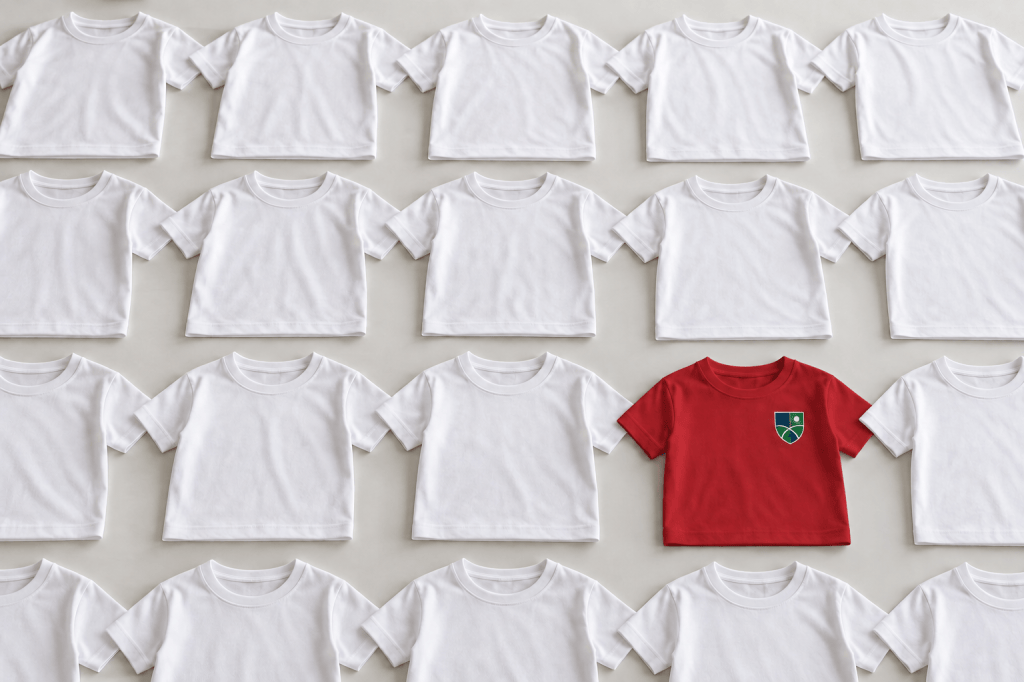
One of our latest extended conversations concerned a change to the PE kit. The school had decided to introduce an official PE T-shirt bearing the school logo. I will spare you the details of the hundreds of messages generated by what seemed like a fairly clear and specific rule. I will also spare you the previous discussions about exactly what children were allowed to wear before the official T-shirt was introduced. It seems that no rule can ever be quite specific enough to prevent a school WhatsApp group from springing into action.
But with the beginning of the new academic year, the discussion made me think about a broader question: why does adding a school logo make an item of clothing so much more expensive?
If you have children at school—or remember buying uniform yourself—you will probably recognise that school uniform effectively comes in two forms. Some items carry the school logo, commonly jumpers, blazers, jackets or PE shirts. Others are generic: trousers, skirts, shirts, polo shirts and ordinary T-shirts that can be bought from many different retailers, often at a much lower price.
Parents therefore frequently buy only one or two versions of the branded items and supplement them, whenever the school permits it, with cheaper generic alternatives. The reason is simple: branded school uniform costs more. Two T-shirts may have very similar material, quality and design, but adding the school logo can create a considerable difference in price.
Why does this happen? Part of the answer is obvious: producing or embroidering a logo costs something. But that small production cost is unlikely to explain the entire price difference. The more important explanation concerns competition. An ordinary white T-shirt has many close substitutes. If one shop charges too much, parents can buy an almost identical shirt somewhere else. Once a particular school logo becomes compulsory, however, those alternatives are no longer acceptable substitutes. A standard product becomes differentiated, the number of possible suppliers shrinks, and the remaining seller—or sellers—gains greater market power.
The difference also reflects economies of scale. A retailer can order thousands—or even millions—of generic white T-shirts and sell the same product in stores across the country. The costs of designing the shirt, setting up the machinery, negotiating with manufacturers, transporting stock and organising distribution can therefore be spread across a very large number of units. This lowers the average cost of producing and selling each T-shirt. A shirt carrying the logo of one particular school has a much smaller market. It may need to be produced or embroidered in relatively small batches, while the costs of setting up the design, holding different sizes in stock and distributing the shirts are spread across far fewer purchases. The cost per shirt is therefore likely to be higher.
But let me return briefly to the school WhatsApp conversation. Before the official shirt was introduced, the instruction could hardly have sounded simpler: children should wear a white T-shirt for PE. What could possibly be unclear about that? Quite a lot, apparently. It generated questions about exactly what counted as white, how much of the T-shirt needed to be white, and more variations on the white-T-shirt question than I had ever imagined could exist.
The official PE T-shirt therefore does provide something of value. It removes uncertainty about what counts as an acceptable T-shirt. Parents no longer have to search for an item and then determine whether it complies with the school’s instructions, while the school no longer has to interpret numerous slightly different versions of the same garment. In economic terms, standardisation can reduce information, search and coordination costs. Branding may also make the uniform more recognisable and contribute to a shared school identity.
There is therefore a genuine economic trade-off. Requiring a branded T-shirt makes the item more expensive, removes cheaper substitutes and weakens competition. At the same time, it creates a clear and consistent standard that is easier for everyone to understand. And, by reducing coordination costs, it should theoretically produce fewer WhatsApp messages.
In theory.


Leave a comment